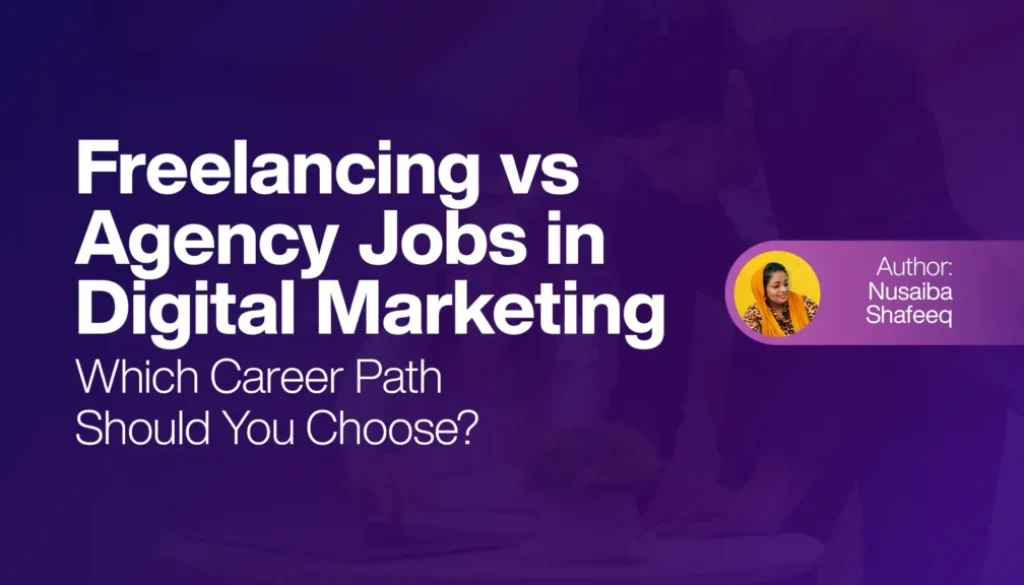
Freelancing vs Agency Jobs in Digital Marketing: Which Career Path Should You Choose?
Over the last decade, Digital Marketing has created numerous career opportunities as businesses shift more of their marketing efforts online.
This trend has led to a growing demand for skilled digital marketers.
For those starting out, one of the main questions is whether to begin as a freelancer or work in a digital marketing agency.
Both paths offer different experiences and growth opportunities, but differ significantly in terms of work environment, income, and skill development. Understanding these differences can help newcomers choose the path that best suits their goals and working style.
Table of Content
What Is Freelancing in Digital Marketing?
Freelancing means working independently and offering marketing services directly to clients rather than being employed by one organisation.
Freelancers often specialise in areas like Search Engine Optimisation, Social Media Marketing, paid advertising, website optimisation, and Content Marketing.
Flexibility is one of the most significant benefits of working as a freelancer.
Freelancers have the freedom to decide their work hours and location. Many digital marketers enjoy the ability to work from home, choose their projects, and set their own schedules.
Another benefit is the potential to earn more as you gain experience.
Unlike traditional jobs with fixed salaries, freelancers can increase their income by working with multiple clients or offering specialised services.
However, freelancing also has its challenges.
It can take time to find consistent clients, especially for beginners. Freelancers must actively promote their services, build a portfolio, and develop strong networking skills.
Income stability can be unpredictable in the early stages.
The volume of projects can vary from month to month, with some periods being busier than others. Because of this, freelancers need good time management skills and the ability to handle both marketing work and client communication.
Working in a Digital Marketing Agency
Agency jobs offer a completely different working environment.
Instead of working independently, marketers collaborate with a team to manage campaigns for various businesses.
Most digital marketing agencies manage multiple client accounts, offering services like SEO, social media management, paid advertising, email campaigns, and website development.
This environment allows marketers to gain exposure to different industries and marketing strategies.
For beginners, working in an agency can be very beneficial.
Agencies usually have experienced professionals who guide junior marketers through real campaigns. This mentorship helps beginners learn practical skills more quickly.
Another advantage is financial stability.
Agency employees receive a fixed salary, which provides consistent income and reduces the uncertainty often associated with freelancing.
However, agency work involves structured schedules and deadlines.
During busy campaign periods, workloads can significantly increase. Employees must also follow company processes and collaborate closely with team members.
Despite these challenges, agency experience is often considered one of the best ways to build a solid foundation in digital marketing.
Skill Development: Agency vs Freelancing
Skill development is an important factor when choosing between these two career paths.
Working in an agency often provides faster learning opportunities for beginners.
Marketers get to observe experienced professionals, participate in team discussions, and work on multiple campaigns at once. This exposure helps them understand how strategies are planned, executed, and optimised.
Freelancers, on the other hand, usually learn through independent practice and experimentation.
While this can be challenging at first, it also encourages problem-solving and adaptability.
Over time, freelancers develop additional skills such as client management, negotiation, personal branding, and business development.
These skills are valuable for anyone looking to build a long-term career as an independent marketing professional.
Flexibility and Work-Life Balance
One of the most significant differences between freelancing and agency roles is the level of flexibility they offer.
Freelancers generally enjoy greater control over their schedules.
They can decide how many projects to take on and when to work on them. This flexibility allows them to create a work-life balance that suits their personal preferences.
Agency employees typically follow fixed working hours and company routines.
While this may feel restrictive for some people, others appreciate the structured environment and clear separation between work and personal life.
Ultimately, the right choice depends on individual personality and lifestyle preferences.
Long-Term Career Growth
Both freelancing and agency jobs offer excellent long-term career opportunities in digital marketing.
Many successful marketers begin their careers in agencies to gain practical experience and build industry knowledge.
After developing strong skills and professional networks, some transition into freelancing or consulting.
Others continue growing within agencies, moving into leadership roles such as digital marketing manager or strategy director.
Because digital marketing continues to evolve with new technologies and platforms, professionals who stay updated with industry trends will always find opportunities for growth.
Conclusion
Choosing between freelancing and agency jobs in digital marketing depends largely on personal goals, work preferences, and career ambitions.
Agency roles offer structured learning, mentorship, and stable income, making them an excellent starting point for beginners.
Freelancing provides independence, flexibility, and the opportunity to build a personal brand while working with diverse clients.
For many marketers, the ideal path is to start in an agency, gain valuable experience, and later explore freelancing when they feel confident in their skills.
Regardless of the path you choose, continuous learning and adaptability are the keys to success in the ever-changing world of digital marketing