
AI
How to Write Better AI Prompts for Marketing (With Real Examples)
Artificial intelligence is no longer something people encounter only in science-fiction movies or research laboratories. It is already being used to recommend products, organise information, generate content, detect patterns, automate workflows, and assist professionals in everyday tasks.
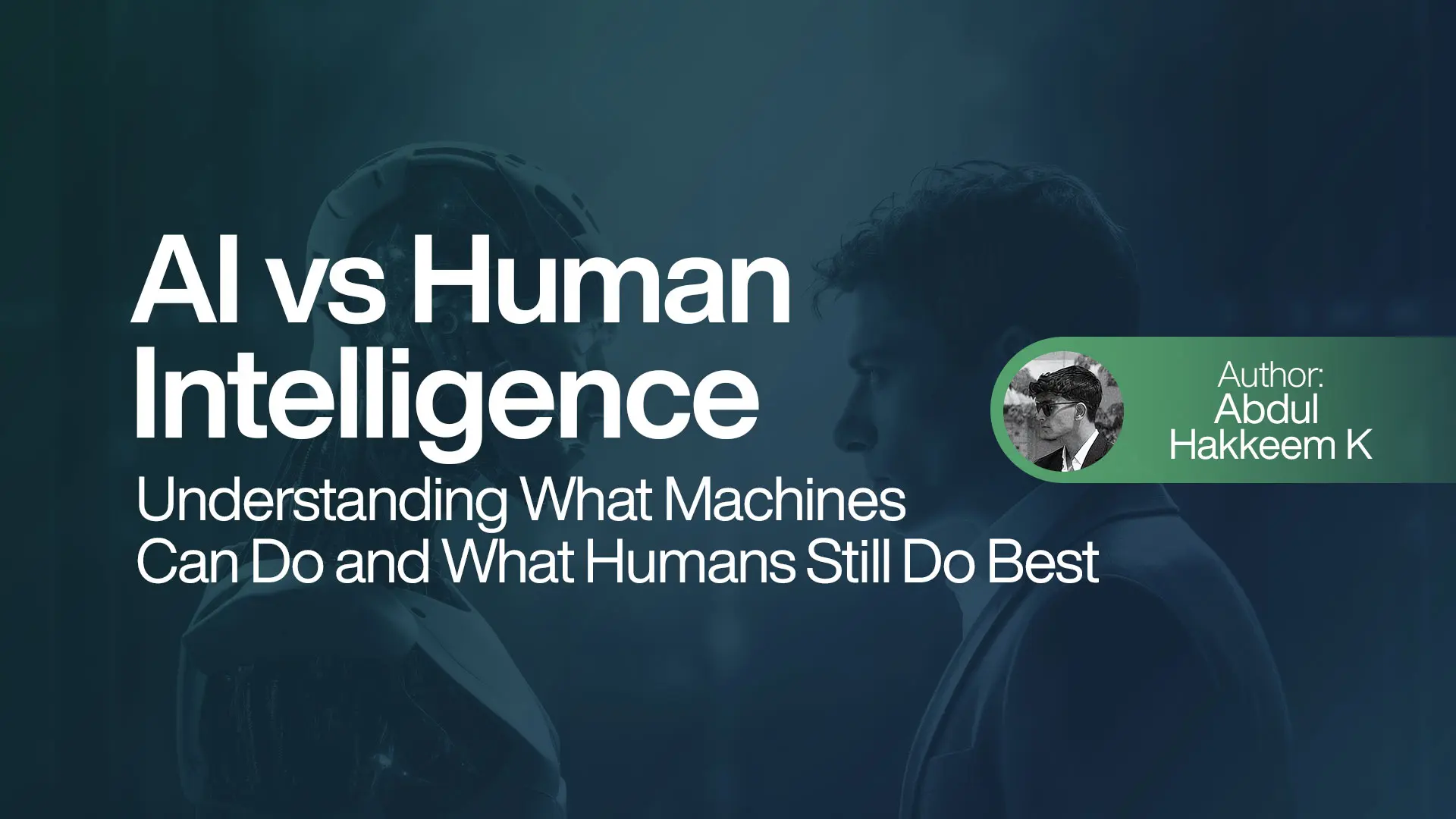
That progress has created an important question: If machines can perform tasks that once required human intelligence, what makes human intelligence different?
The answer is more complicated than simply saying that humans are creative and machines are logical. Modern AI can generate images, write stories, analyse information, and produce solutions to complex problems. Humans, meanwhile, can perform calculations, follow rules, and analyse data.
The real difference becomes clearer when we look at context, purpose, judgment, responsibility, and experience.
AI can be remarkably capable within the tasks it is designed to perform. Human intelligence operates across changing situations, relationships, values, and real-world experiences. Understanding this distinction can help students, professionals, creators, and business owners decide where AI can assist them and where human involvement remains essential.
Artificial intelligence refers to technologies that enable computer systems to perform particular tasks associated with intelligent behaviour. Depending on the system, this can include recognising patterns, processing language, making predictions, classifying information, generating content, or supporting decisions.
Human intelligence is broader. People learn through experience, understand social situations, interpret emotions, form intentions, adapt to unfamiliar circumstances, and make choices based on both information and personal judgment.
This means a direct competition between “AI” and “humans” can be misleading.
A better comparison is:
What kind of task is being performed, and which type of intelligence is better suited to it?
That question provides a much more useful way to understand the future of work.
Machines are particularly useful when a task involves scale, repetition, structured information, or computational speed.
Imagine a business with thousands of customer records. A person could examine the information manually, but the process would consume considerable time.
An AI-powered system can process large datasets quickly and identify recurring patterns.
This can support activities such as:
The advantage is not that AI automatically understands everything in the data. Its strength lies in processing information efficiently when the system is appropriate for the task.
People naturally become tired when performing the same activity repeatedly.
Software does not experience boredom in the human sense.
This makes automation useful for repetitive workflows such as organising records, moving information between systems, generating routine reports, or responding to common requests.
When routine work is automated appropriately, employees can spend more time on tasks requiring communication, problem-solving, and decision-making.
Computers can perform certain calculations and information-processing operations much faster than humans.
This is particularly useful when a professional needs to examine a large amount of information before making a decision.
However, speed should not be confused with correctness.
A fast answer is useful only when the underlying process and information are reliable.
Human abilities become especially important when a situation cannot be solved simply by following patterns or processing information.
Suppose a restaurant notices that customer orders have fallen.
An analytical system might identify the decline and show when it started.
A human manager may discover the reason by speaking with customers and staff. Perhaps construction has blocked access to the restaurant, a competitor has opened nearby, or customers are unhappy with a recent menu change.
The numbers show what happened.
Human investigation can help determine why it happened and what should happen next.
That difference matters.
Professional decisions often involve information that cannot be completely represented by numbers.
A marketing manager choosing between two campaigns may consider:
AI can provide useful analysis, but a person may still need to balance competing priorities and accept responsibility for the final decision.
Communication is not only about producing correct sentences.
A teacher understands when a student is struggling.
A manager recognises when a team member needs support.
A salesperson understands a customer's hesitation.
A creative director senses whether an idea fits the identity of a brand.
Technology can assist these activities, but human relationships involve experience, trust, emotion, and social context.
Creativity is often presented as proof that humans will always outperform AI.
That argument is too simple.
Therefore, simply saying “AI cannot create” is no longer an accurate description of the technology.
But producing possibilities is only one part of creative work.
A professional still needs to decide:
What should be created?
Who is it for?
What should it communicate?
Why should the audience care?
Does it fit the brand?
Is the idea culturally appropriate?
Does it solve the actual communication problem?
These decisions involve purpose and context.
For example, an AI tool might produce ten advertising concepts in seconds. A human marketer still has to identify which concept fits the customer's needs and the brand's positioning.
The valuable skill is therefore shifting from simply producing content to directing, evaluating, refining, and applying ideas effectively.
This question needs more precision.
A job usually consists of many different tasks.
Some of those tasks may be highly repetitive and suitable for automation, while others may require communication, judgment, creativity, or physical interaction.
Therefore:
Automating a task does not necessarily mean eliminating an entire profession.
Consider a content marketing professional.
AI may assist with:
But the professional may still be responsible for:
The workflow changes, but the human role does not necessarily disappear.
Instead of asking whether AI will take a particular job, it can be more useful to ask:
Which parts of this job can be automated, and which parts become more valuable when technology handles the routine work?
This changes the way professionals should prepare for their careers.
A person who spends an entire day performing repetitive data-entry work may face greater automation risk than someone whose work combines data with strategy, communication, and decision-making.
The same pattern can apply to creative industries.
A designer who only performs repetitive production tasks may experience more technological disruption than a designer who also understands branding, visual strategy, audience psychology, and creative direction.
Technology can therefore change the value of different skills within the same profession.
Learning how to use an AI tool can be useful.
But tools change quickly.
A platform that is popular today may be replaced or significantly redesigned tomorrow.
Long-term professional value comes from understanding the principles behind the tools.
For someone building a digital career, a stronger skill combination might look like this:
Professional expertise + AI literacy + critical thinking + communication
For example, a digital marketer who understands SEO can use AI to accelerate research. A video editor who understands storytelling can use AI-assisted tools without allowing automation to determine the entire creative direction.
The tool becomes more valuable because the professional already understands the work.
The growth of AI does not make every human skill less important.
In some cases, it makes certain skills more valuable.
AI-generated information should not automatically be accepted.
Professionals need to ask:
Being able to explain an idea clearly remains valuable in almost every profession.
AI can help produce options.
Humans still need to determine which option supports the larger objective.
Technology will continue changing. Professionals who can learn new systems and modify their workflows are more prepared for technological shifts.
Knowing an industry, audience, customer, or subject deeply helps professionals judge whether an AI-generated output actually makes sense.
Some decisions involve consequences that go beyond efficiency.
When technology affects people's privacy, opportunities, finances, safety, or reputation, human oversight becomes especially important.
One of the biggest mistakes people make when using AI is assuming that a confident answer must be a correct answer.
AI systems can generate incorrect information, misunderstand instructions, reflect biases, or produce outputs that sound convincing without being sufficiently supported.
This is particularly important when creating professional content.
Imagine an AI tool generates a statistic for a marketing article.
The sentence may look perfectly credible.
Publishing it without verification can still damage the credibility of the website.
A responsible workflow therefore looks like:
Generate → Check → Improve → Verify → Publish
not:
Generate → Publish
This distinction is increasingly important for writers, marketers, designers, researchers, and business owners using AI in their daily work.
The strongest approach is not to make AI responsible for an entire workflow.
Instead, divide the work according to strengths.
The person establishes the objective, audience, requirements, and expected outcome.
AI can help with information organisation, brainstorming, pattern identification, drafting, or repetitive operations.
The professional examines the output for accuracy, relevance, quality, and context.
Where appropriate, AI can help revise or transform the material based on clear instructions.
The final decision remains with the person responsible for the work.
This approach combines machine efficiency with human judgment.
For aspiring professionals and career switchers, the growth of AI should not be viewed only as a threat.
It is also a reason to build broader capabilities.
A future-ready digital professional might combine:
For content creators, AI can speed up parts of production, but storytelling and audience understanding still matter.
For marketers, AI can accelerate analysis and content development, but strategy and positioning remain essential.
For designers, AI can help explore possibilities, while visual judgment and brand understanding guide the final direction.
For business owners, AI can reduce the time required for certain tasks, but business decisions still require knowledge of customers, markets, and objectives.
The goal should not be to become dependent on AI.
The goal should be to become better at your profession because you know when and how to use AI.
AI does not need to be involved in every task.
Sometimes a simple human decision is faster.
Sometimes a sensitive conversation requires a person.
Sometimes an original idea is better developed without automated suggestions.
Sometimes information is too important to accept without independent verification.
Professional AI literacy therefore includes knowing both:
when AI can help
and
when human judgment should take priority.
That distinction can prevent over-automation and improve the quality of work.
The answer depends on how technology is used.
AI can increase the speed and scale of many activities. Humans can provide direction, context, responsibility, and purpose.
When used poorly, AI can produce inaccurate information, repetitive content, biased outcomes, and unnecessary automation.
When used thoughtfully, it can reduce routine workload and give professionals more time for higher-value activities.
The future is therefore unlikely to be a simple contest between machines and people.
It is more likely to be a workplace where professionals who understand both their own strengths and AI's capabilities can create better workflows.
What is the main difference between AI and human intelligence?
AI is built to perform specific computational or information-processing tasks, whereas human intelligence operates across broader domains such as experience, context, social understanding, judgment, and responsibility.
Is AI smarter than humans?
There is no single answer because AI performance depends on the task. AI can outperform humans in certain computational and pattern-based activities, while humans remain stronger in many areas involving context, social interaction, and judgment.
Can AI replace every job?
No simple answer applies to every occupation. AI can automate individual tasks, but many jobs contain a mixture of technical, creative, interpersonal, and decision-making responsibilities.
What should students learn in the age of AI?
Students should develop AI literacy alongside communication, critical thinking, creativity, problem-solving, domain knowledge, and practical professional skills.
Is human creativity still valuable when AI can generate content?
Yes. AI can generate many forms of content, but people still need to establish objectives, understand audiences, select ideas, provide creative direction, evaluate quality, and decide how an output should be used.
How can professionals use AI responsibly?
Professionals should use AI according to the requirements of the task, verify important information, protect sensitive data, review generated outputs, and retain appropriate human oversight.
The rise of artificial intelligence does not make human intelligence irrelevant.
Instead, it changes the way human intelligence is applied.
Machines can help process information, automate repetitive work, generate possibilities, and support analysis. People bring purpose, context, judgment, communication, experience, and accountability.
For anyone preparing for a digital career, the most useful mindset is not to ask:
“How can I compete against AI?”
Ask instead:
“How can I become more capable by learning to work with AI?”
That shift can turn AI from something to fear into a tool to understand.
The professionals who stand out in an AI-driven workplace may not be the ones who use the most tools. They may be the ones who understand which tool to use, when to use it, how to question its output, and where human judgment must remain in control. Building these skills starts with the right practical training, such as AI-driven digital marketing courses at CDA Academy, where learners can develop the confidence to use AI strategically while keeping creativity and human insight at the centre.